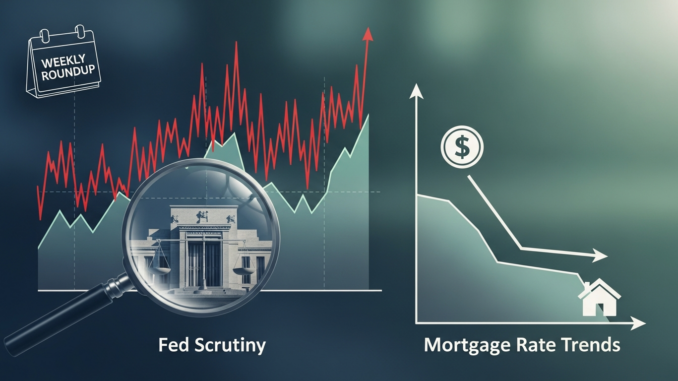
This week in finance was marked by stock market fluctuations, increased scrutiny of monetary policy, and renewed attention on mortgage rate trends. While no single shock dominated the headlines, a combination of uncertainty and cautious investor behavior shaped market movements across the globe.
This finance weekly roundup summarizes the most important developments and explains why they matter.
Stock Markets Experience Uneven Performance
Equity markets saw noticeable swings throughout the week as investors reacted to a mix of economic signals and policy-related discussions. Major indices moved within a narrow but volatile range, reflecting hesitation rather than strong conviction.
Market participants appeared selective, favoring stability over aggressive growth. This pattern often emerges when investors are unsure about the near-term economic outlook but do not anticipate a major downturn.
Federal Reserve Scrutiny Influences Market Sentiment
Increased public attention on the Federal Reserve played a key role in shaping investor psychology. Discussions around interest rates, policy direction, and institutional independence raised questions that markets tend to react to quickly.
Even without immediate changes to policy, scrutiny alone can influence expectations. Markets generally respond to clarity and consistency, and any uncertainty surrounding decision-making processes can lead to cautious trading behavior.
Mortgage Rates Remain a Key Focus for Households
Mortgage rates remained an important topic this week, especially for prospective homebuyers and homeowners considering refinancing. While rates have stabilized compared to previous periods of rapid change, they remain sensitive to broader interest rate expectations.
For many households, even small shifts in borrowing costs can significantly impact affordability. As a result, mortgage trends continue to attract attention alongside broader financial news.
Banking and Financial Sectors Under Pressure
Financial stocks faced modest pressure during the week, reflecting concerns about lending margins and regulatory uncertainty. Banks are closely tied to interest rate movements, and shifting expectations can quickly affect profitability outlooks.
Although the declines were not dramatic, the sector’s performance contributed to overall market caution and reinforced defensive investment strategies.
Global Markets Echo U.S. Developments
International markets largely followed the tone set by U.S. financial news. European equities showed mixed results, while Asian markets ended the week unevenly as local economic data competed with global concerns.
Currency and commodity markets also reflected mild risk aversion, underscoring how interconnected global financial systems have become.
What This Week’s Trends Indicate
This week’s financial developments suggest an environment defined by uncertainty rather than instability. Economic growth continues, but investor confidence depends heavily on policy clarity and predictable decision-making.
Markets are increasingly influenced by expectations, communication, and long-term outlooks rather than short-term data alone.
Looking Ahead
In the coming weeks, attention will remain focused on economic indicators, policy statements, and interest rate expectations. Clear guidance from financial institutions could help reduce volatility, while continued ambiguity may keep markets cautious.
Staying informed through reliable, fact-based reporting remains essential for understanding these evolving trends.
Final Thoughts
This finance weekly roundup highlights how stock market swings, policy scrutiny, and mortgage rate trends are shaping today’s financial landscape. While short-term movements may fluctuate, long-term stability depends on transparency, consistency, and trust in economic institutions.
Understanding the broader context behind financial headlines helps readers navigate uncertainty with greater confidence.
Leave a Reply